- High Rent: Expect an average studio rent of about €900 per month in Paris.
- Act Quickly: High demand means listings disappear fast.
- Budgeting Rule: Allocate 30–40% of your income for rent, plus utilities.
- Prepare Your File: Gather all required documents (ID, enrollment, funds, guarantor) before visiting apartments.
Are you studying French in Paris? At FTC Paris, you do not just master the language. You dive into the heart of the City of Lights. This is an exciting adventure. However, it can quickly become stressful. This is especially true when finding accommodation.
Here are our practical tips to help you overcome this first hurdle to your Parisian life.
Understanding the Paris Housing Market
Paris is not the world’s most expensive city. Yet, it ranks among Europe’s top 10 for high rents. Expect to pay about €900 per month for a cozy studio. Demand is much higher than supply. Therefore, listings disappear quickly, sometimes in a few hours. Prices vary greatly by neighborhood. Knowing the geography is crucial.
Paris has 20 districts, called arrondissements. They spiral out from the center:
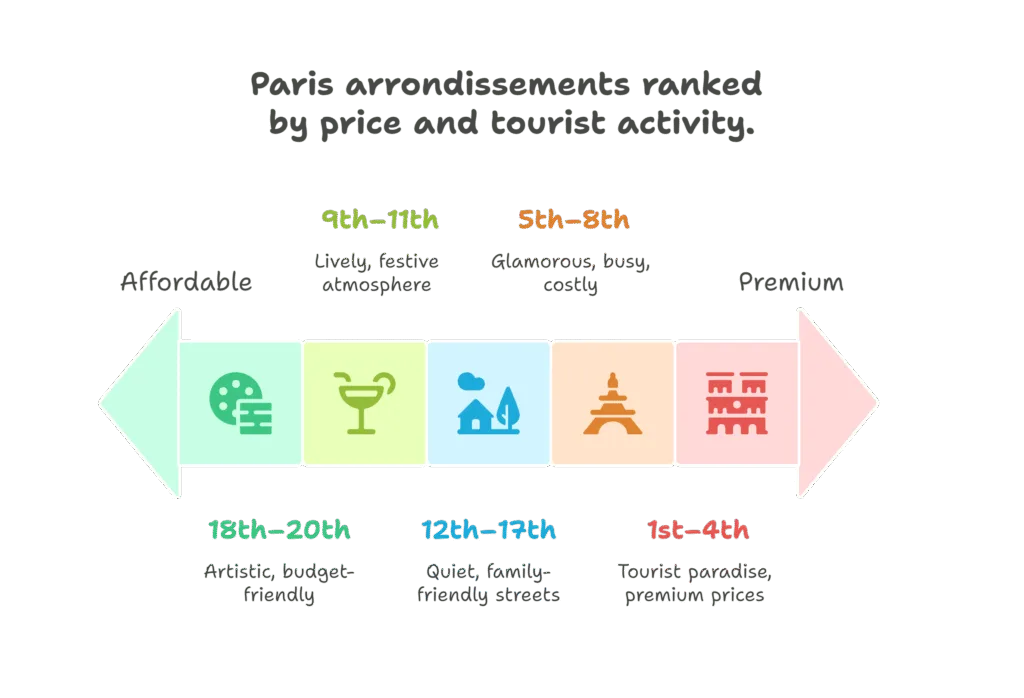
- Central Vibe (1st–4th): A tourist paradise. Sites include the Louvre, Notre-Dame, and the chic Marais. Expect premium prices for this ideal location.
- Iconic Places (5th–8th): The lively Latin Quarter and Luxembourg Gardens. The glamour of the Champs-Élysées and Eiffel Tower views. It is busy and quite costly.
- Trendy Energy (9th–11th): Trendy bars, lively restaurants, and endless shops. This is ideal for a festive atmosphere without spending too much.
- Quiet Residential (12th–17th): Quieter streets and a family atmosphere. Perfect if you need rest after classes.
- Affordable North (18th–20th): Artistic pockets with the lowest rents. Think of the charm of Montmartre combined with budget savings.
What about outside the city? Suburbs, or banlieue, are often cheaper. Choose carefully. Western areas like Neuilly-sur-Seine or Boulogne-Billancourt are luxurious. They have high rents for prestige and parks. Cities like Montreuil or Saint-Ouen offer more moderate prices.
Act fast and stay organized. In Paris, the first to visit with a complete, printed file is often the one who gets the keys.
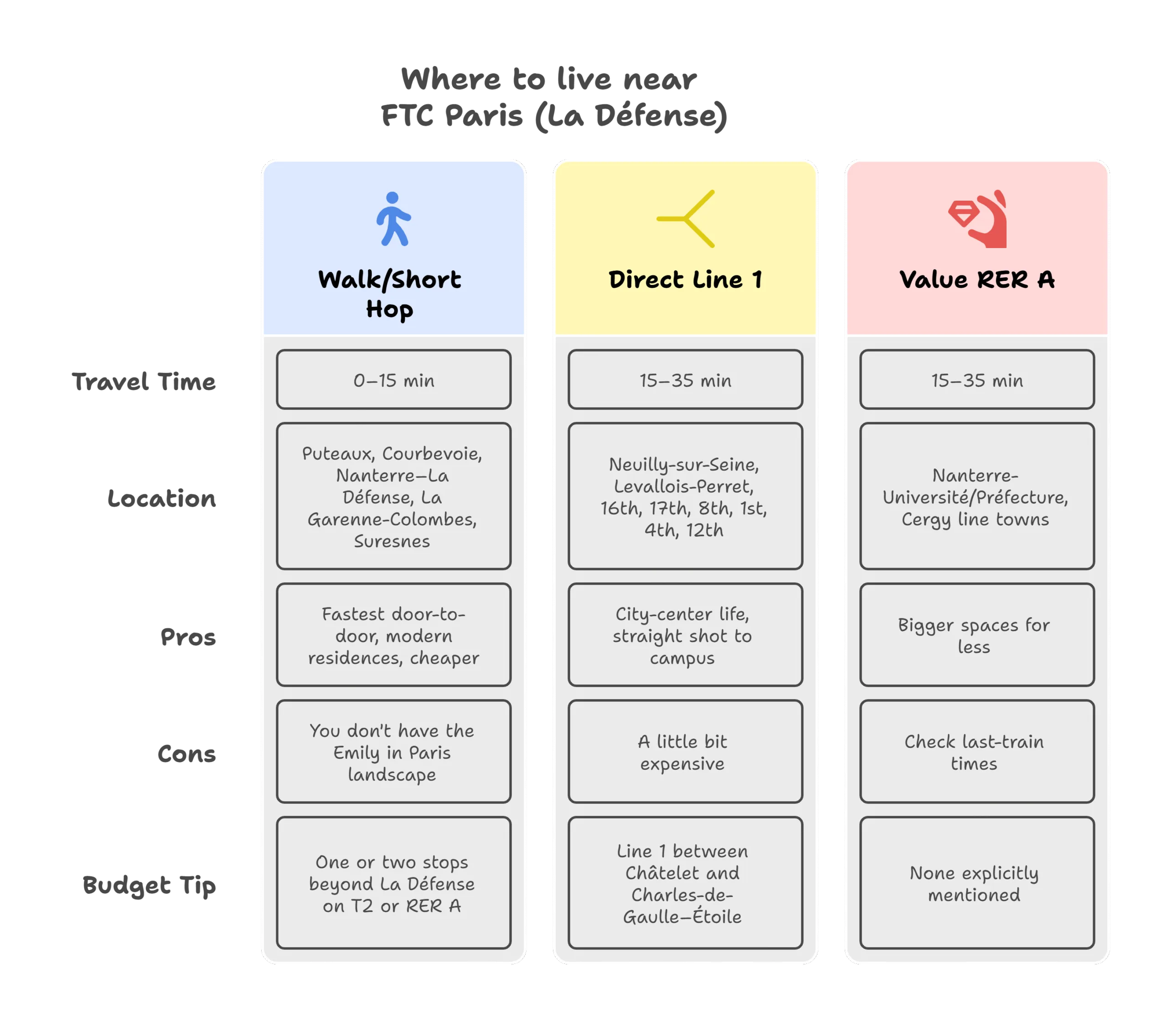
Find Your Base: Short Hops & Direct Lines to FTC Paris
Want a quick look at the campus area first? See the FTC Paris center and plan your route before booking visits to ensure your commute is smooth.
Step 1: Define Your Needs and Budget
- Set a realistic budget: Aim for 30–40% of your income for rent. Add about €100–€150 per month for utilities (electricity, internet, etc.).
- Choose your ideal location: But do not be too rigid. Being close to a direct metro line is often better than living exactly in the center.
- Shared or solo? Shared apartments (colocs) divide costs. Websites like Appartager.com or Coliving connect you with roommates.
Step 2: Explore Listings and Visit
- Online search: Use Leboncoin, Seloger, or Logic-Immo. Filter by size (studio: 20–30 m²), price, and arrondissement. Turn on alerts for new listings.
- Agency vs. direct: Agencies (like Orpi or Century 21) handle paperwork for a fee (usually about one month’s rent). Talking directly with the owner saves money. Warning: Never pay a deposit before signing a lease. If they ask for it early, it is a scam.
- Schedule visits ASAP: Email or WhatsApp owners immediately. Bring a friend for a second opinion.
Step 3: Prepare Your Rental Application File
Landlords check your ability to pay. Do not skip this. As an FTC Paris student, highlight your enrollment to boost your credibility. Gather these documents (you need certified translations if they are not in French):
For Students:
- Valid ID (passport or residency permit).
- FTC Paris enrollment certificate.
- Proof of funds: Scholarship letter, parental transfer guarantee, or part-time work contract. You do not need payslips if you are new in France.
- Guarantor letter if you have one, or use a private service like Garantme.
- Visale: Visale is a public, free guarantor service. Apply before visits to strengthen your file. Some owners prefer private guarantors, so ask early.
If you also work:
- Same ID and proof of funds (last 3 payslips).
- Employer’s certificate (permanent/fixed-term contract).
Tip: Compile everything into one clear, single PDF file ready to be emailed.
Step 4: Lease & Legal (What students must know in 2026)
- Lease types: Furnished (meublé) standard lease is 1 year. For students, a specific 9-month non-renewable furnished lease exists. Unfurnished (vide) standard lease is 3 years.
- Security deposit (dépôt de garantie): For furnished, up to 2 months’ base rent (excluding charges). For unfurnished, up to 1 month’s base rent. The landlord must return it within 1 month after keys are handed back if there are no deductions (2 months if deductions apply).
- Inventory of fixtures (état des lieux): Mandatory at move-in and move-out. Attach photos, note meter readings, and keep a signed copy.
- Home insurance (assurance habitation): Obligatory for all tenants. You must provide an attestation at signing. The minimum is “risques locatifs” (fire, water damage).
- Notice period (préavis): Unfurnished is typically 3 months, reduced to 1 month in a “zone tendue” (Paris is one). Furnished is 1 month. Always use registered mail.
Bonus Step: APL & Good tips to know
- APL (Housing Aid): Many students (including internationals with a valid residence status) can get financial help from the government. Simulate your eligibility and amount online, then apply after you move in.
- Rent Control: Most rentals in Paris must respect a reference rent (loyer de référence) and ceiling (loyer de référence majoré) set by prefectural order. These values must appear in the lease. Check the official map/simulator before signing.
FAQ: Housing in Paris
Traditionally yes. However, as an international student, you can use government-backed services like Visale for free, or private services like Garantme to act as your guarantor.
A furnished lease (meublé) typically lasts 1 year (or 9 months for students) and requires a 1-month notice period before leaving. An unfurnished lease (vide) lasts 3 years with a 1 to 3-month notice period depending on the zone. The required security deposit also differs.
Yes! As long as you have a valid residence permit (titre de séjour) and are paying rent in France, you can apply for the APL through the CAF (Caisse d’Allocations Familiales).
Official Housing Resources & Links:
- Service-Public.fr — Official rules for renting and leases in France.
- Visale.fr — Free public guarantor for students.
- CAF.fr — Family Allowance Fund (for housing aid / APL).
- Paris.fr — Official simulator for rent control ceilings.
Prepare your arrival in Paris
You might also like
More articles to help you make the most of your time in France.
French School Prices in Paris: What to Compare
How to compare French courses in Paris? Look beyond price: class size, hidden fees & environment matter.
Study & ExamsHow Our Intensive French Method Works
Beyond grammar: discover the active method behind our intensive French course Paris. Small groups & real practice.
MoneyOpen a Bank Account in France in 2026
Need a French RIB? The ultimate guide to open a bank account for your intensive french course paris.